
Bordeaux
Left Bank elegance meets Right Bank power in a region where wine and history are inseparable. When Napoleon III commissioned the 1855 Classification for the Paris Exposition Universelle, he didn't just rank wines — he codified a hierarchy that has defined prestige for over 170 years. Those rankings still govern the world's perception of fine wine, and the châteaux behind them remain among the most coveted estates on earth. But Bordeaux's story runs deeper than any classification. This is a city shaped by Roman viticulture, English commerce, Enlightenment architecture, and a Golden Triangle of 18th-century grandeur that earned UNESCO World Heritage status. From the gravel banks of Pauillac to the limestone plateau of Saint-Émilion — itself a medieval pilgrimage town carved into the hillside — Bordeaux rewards those who arrive with the right introductions. Our relationships provide access to private tastings within Grand Cru Classé estates, vertical collections that reveal decades of aging potential, barrel sampling alongside maîtres de chai, oyster farms along Arcachon Bay, truffle markets in Périgueux, Saint-Émilion's subterranean monuments, and the architectural grandeur of properties where winemaking and French history have been inseparable for centuries. Wine opens every door in Bordeaux — to the cellars, the kitchens, and the stories that never make it into the guidebooks.
CULINARY ARTS
The cuisine of Bordeaux is shaped by its geography — Atlantic coastline, river estuaries, and the rich agricultural heartland of Périgord converge to create one of France's most distinctive culinary traditions. Shuck freshly harvested oysters at family-run farms along Arcachon Bay, paired with crisp Entre-Deux-Mers whites as the tide rolls in. Master the art of the canelé — Bordeaux's iconic rum and vanilla custard pastry — in hands-on baking workshops led by local pâtissiers. Learn the techniques behind entrecôte bordelaise, the region's signature bone marrow and red wine reduction that elevates simple cuts into something extraordinary. Journey inland to Périgord for foie gras production tours at artisan farms, truffle hunting through ancient oak forests with trained dogs, and seasonal market visits where black diamonds command reverence. Experience La Cité du Vin's immersive sensory exhibitions, where Bordeaux's 2,000-year relationship with wine comes alive through taste, scent, and storytelling.
CULTURE & LEISURE
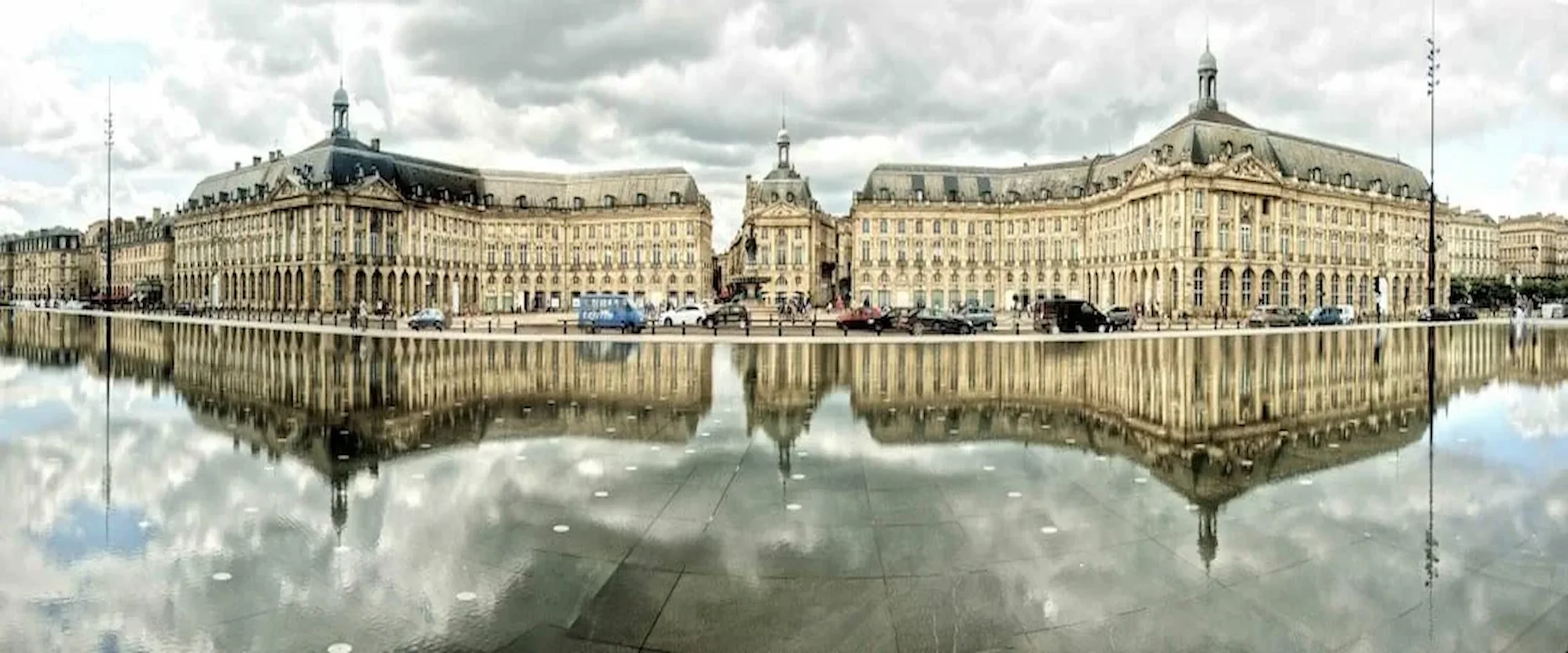
Bordeaux is a city that reveals its grandeur on foot. Walk the Golden Triangle — a district of 18th-century neoclassical façades, private hôtels particuliers, and limestone colonnades that earned the city center UNESCO World Heritage status in 2007, recognizing one of the largest preserved urban ensembles in Europe. Stand before the Place de la Bourse at dusk, where the Miroir d'Eau — the world's largest reflecting pool — transforms the square into a shimmering illusion of light and architecture. Explore the Musée d'Aquitaine, where 25,000 years of regional history unfold — from prehistoric Aquitaine through Roman Burdigala, the English wine trade that shaped the modern city, and Bordeaux's complex role in the Age of Enlightenment and the Atlantic economy. Take your seat inside the Grand Théâtre, a masterpiece of neoclassical design that inspired Charles Garnier's Paris Opéra, for an evening performance beneath its painted ceiling. Beyond the city, cycle the quiet château-lined routes of the Médoc, where gravel roads connect First Growths and forgotten estates in equal measure. Descend into Saint-Émilion's extraordinary underground monolithic church — the largest of its kind in Europe — carved entirely from limestone by Benedictine monks in the 12th century. And for something the vineyards can't offer, climb the Dune of Pilat, Europe's tallest sand dune, where the Atlantic, the pine forests of Les Landes, and Arcachon Bay unfold beneath you in a single panoramic sweep.
ARTISAN TRADITIONS
The craftsmanship of Bordeaux extends far beyond the cellar. Visit working cooperages where tonneliers shape French oak over open flame — a craft virtually unchanged since the 17th century — and learn how toast levels and grain tightness influence the wines aging inside. Step into Cadiot-Badie, a Bordeaux chocolatier since 1826, where four generations have refined the art of ganache and praline using techniques that predate industrial confectionery. Along the banks of the Garonne, traditional boat-builders still construct gabares — the flat-bottomed vessels that once carried wine barrels downriver to the port of Bordeaux, connecting château to commerce for centuries. In the salt marshes near the Gironde estuary, artisan sauniers harvest fleur de sel by hand using methods passed down since Roman occupation, producing crystals prized by chefs across France. And in the limestone quarries that gave Bordeaux its golden façades and Saint-Émilion its underground churches, stone carvers demonstrate the techniques that literally built this region — the same soft calcaire that shapes the architecture above and the cellars below.